
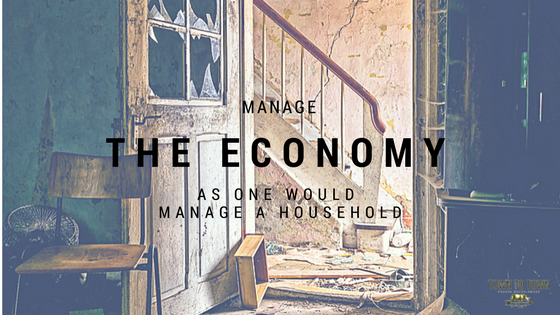
The word economics originally comes from the Greek word “oikonomia” meaning household management. Whether we are speaking of home economics or global economics the general principle is the same. A household requires that it’s manager set budgets and priorities in order that the household will be livable, comfortable, clean, healthy, and in good repair for the indefinite future (Farley, Erickson and Daly). It is about time that all humans become conscious of the fact that the earth is the greater household of the human species and should be managed as such. Inevitably, everything will break down, but if one would perform routine maintenance tasks it could uphold stability. This management of our earthly household could include wilderness conservation, waste clean up, stewardship of species and resources, equal distribution of labor, innovative thinking, international polices, and monitoring the size of the footprint we are leaving on the earth.
“Wilderness is not a luxury but a necessity of the human spirit, and as vital to our lives as water and good bread. A civilization which destroys what little remains of the wild, the spare, the original, is cutting itself off from its origins and betraying the principle of civilization itself.”
― Edward Abbey
Throughout civilization, humans harvest, obtain and trade for natural and man-made resources, which they then transform, use, or consume and create waste from this process or eventually dispose of the resource. Excluding solar energy and any other unconventional means, the resources humans use come from our finite planet so we need to study our ecosystems and monitor these resource levels. Excepting space travel, we also dispose of the by-products of our economy in our earthly household. Thinking of our greater household in this finite way paints a different perspective than the current conventional economic theory and practice. It is not that other economic perspectives do not exist; it is simply that this one economic belief has begun to engrain itself in our common culture and daily life.

As one looks around you can begin to realize how every aspect of our lives can be ruled by “the economy”, this invisible force which takes on a momentum of it’s own. Consumerism, and a throwaway society have replaced quality, durable products. Costs to our environment are not included in human’s analysis of the “costs of doing business”. Our economy should rather be a tool to organize our lives, not a wave which we are forced to ride. Rather than use innovation to make our earthly household obsolete (which is unlikely anyway), we must utilize and improve upon some of the incredible, novel, and appropriate technologies, which can be sustainable on a personal household or global scale.
Wrap your mind around this economic paradigm:

"The inherent vice of capitalism
is the unequal sharing of blessings;
the inherent virtue of socialism
is the equal sharing of miseries."
- Winston Churchill
Mindsets form subconsciously so it is often hard to notice them, and even harder to change them but the first step is to become aware of our economic actions and the results of that. Be aware of our consumption of resources both on a corporate and personal level. How far are the resources transported to reach us? What packaging are they in? What quantity is being used? What waste is being generated? Don’t be afraid to learn more, wonderful innovation already exists. Companies are designing with the end of the product’s original life purpose in mind in order to minimize waste. Governments are redefining national progress as dependent on quality of life. Developers are pioneering sustainably planned housing and transportation. Cities are collecting, sorting and recycling trash in a multitude of clever waste management systems. The poor of the earth are scavenging landfills for items that have not yet met their useful end. How can you repurpose something you were about to throw away? How can you obtain the resources you bring in to your household in a more sustainable way?


A new world order is emerging. In seventy years the earth’s population has tripled and it will only continue to increase exponentially. As the population grows, the planet gets smaller and smaller. More and more people are vying for the same limited resources. In our current system it would simply not be possible for all of the earth’s 7.6 billion human inhabitants to live at the same standard of living of present day Americans. A new world order calls for human’s greatest talent - innovation. Innovation can begin at any level but can lead to positive or detrimental technologies, therefore we need to pay attention to who is holding the purse-strings and hold organizations accountable to a triple bottom line of environmental, social, and financial benefits. Every little bit will count.
For more information:
Read about economics from the source, the founder of modern day economic thought, Adam Smith
Some new insights on Ecological Economics from Yale University
Or find out from about this different idea, Ecological Economics, from UVM
Take a socially, environmentally, and economically friendly trip:
Let Town to Town plan your itinerary
Works Cited
Farley, Joshua, Jon D Erickson and Herman Daly. Ecological Economics Workbook. Washington D.C.: Island Press, 2005.

